Rainwater collection
Rainwater Collection Systems
Your roof already collects the water. A collection system decides whether it goes into a tank or into the ground beside your foundation.
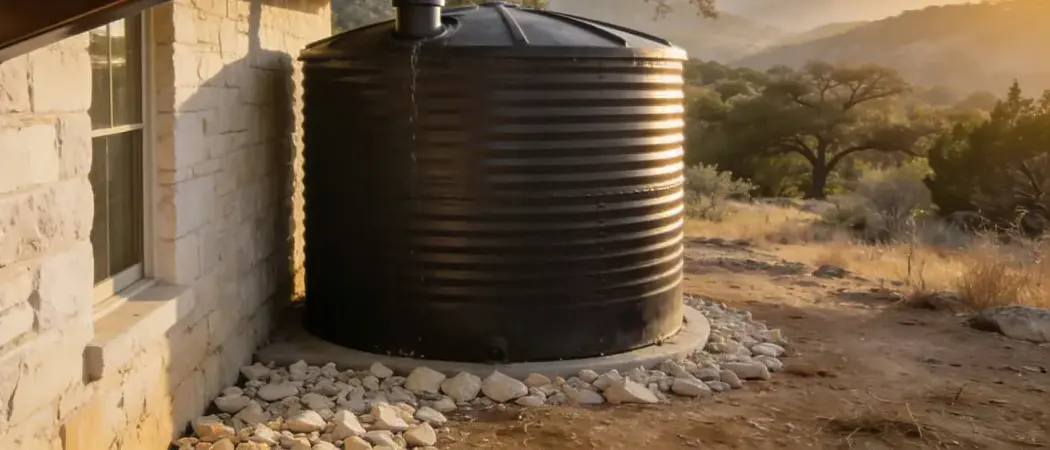
Why Hill Country homes collect rainwater
Two reasons, and they are different. On acreage properties on well water, roof water is a real supply worth capturing, particularly through a dry summer. In town, it is more often about not sending several hundred gallons into the same corner of the yard every time it rains.
Either way it starts with the same thing: gutters and downspouts that actually carry the water where you want it.
How rainwater collection ties into your gutters
The gutter run collects, the downspout carries it down, and instead of discharging at the ground it feeds the tank. We size the downspouts for the roof area, put a first-flush arrangement in where it makes sense so the initial dirty runoff does not go in the tank, and fit an overflow so a full tank in a heavy storm sends the excess away from the house rather than around its base.
The overflow matters more than people expect. A tank with nowhere to overflow to is a very expensive way to water your foundation.
What we handle and what we do not
We do the gutter side properly: the runs, the downspouts, the routing into the tank, the overflow, and getting the water away from the slab. Tanks, pumps, filtration and anything to do with potable use is specialist work.
Tell us what tank you are planning, or what you are thinking about, and we will tell you plainly which parts of the job we handle and which want a specialist.
How to size gutters for a rain tank
Roof area drives everything. A larger roof plane collects a surprising amount from a modest rain, which is why the downspout feeding a tank often needs to be bigger than the one it replaced, and why six inch gutter is common on collection jobs.
We will measure the contributing roof area and tell you what the runs and downspouts need to be for the tank you are planning.
Where rainwater collection works best
Spring Branch and Canyon Lake properties on acreage are the usual ones, along with rural places out toward Geronimo and Marion where lots are bigger and mains water is not the default. It works in town too, just for different reasons. Either way, the overflow has to go somewhere other than your foundation, which is the whole point of why water at your slab matters.
Questions about rainwater collection
Do you install the rain tank?
We handle the gutter side: the runs, the downspouts, the routing into the tank, the overflow, and getting the water away from the slab. Tanks, pumps, filtration and anything to do with drinking water is specialist work. Tell us the tank you are planning and we will say plainly which parts we do.
What does rainwater collection cost?
It depends on the roof area feeding the tank, whether the downspouts need to be bigger, how far the water has to travel to reach the tank, and where the overflow has to go. Height and the number of runs feeding the tank matter too. We measure the contributing roof and give you a price for the gutter side before we start.
Do I need six-inch gutters for rainwater collection?
Often, yes. A big roof plane collects a surprising amount of water from a modest rain, so the gutter and downspout feeding a tank usually need to carry more than the ones they replace. Six inch is common on collection jobs for that reason. We measure the roof area and tell you what your tank needs.
What about leaves getting into the tank?
That is what a first-flush setup is for. Where it makes sense, we fit one so the first dirty runoff off the roof bypasses the tank. Under heavy live oak or cedar, a gutter guard keeps most of the leaves out of the channel in the first place, and we will tell you if your roof needs one.
One call
Tell us what your roof is doing.
Call and you will talk to somebody who does the work. If we cannot get to you, we will say so.
Mon to Fri 8am to 8pm
Saturday 9am to 7pm
Sunday 9am to 8pm