What is under your house
The Balcones Escarpment runs right through New Braunfels. West of it is the Hill Country proper: limestone close to the surface, with thin soil on top. East of it the ground opens into the Blackland Prairie, with deep clay soils.
Clay is the one that matters for a slab. It swells as it takes on water and shrinks as it dries. A slab sitting on clay rides that movement. When the whole house stays about equally wet or equally dry, the movement is fairly even. The trouble starts when one spot gets soaked every time it rains and the rest does not.
A downspout that empties at a corner of the house is exactly that one spot.
What roof water does at the slab
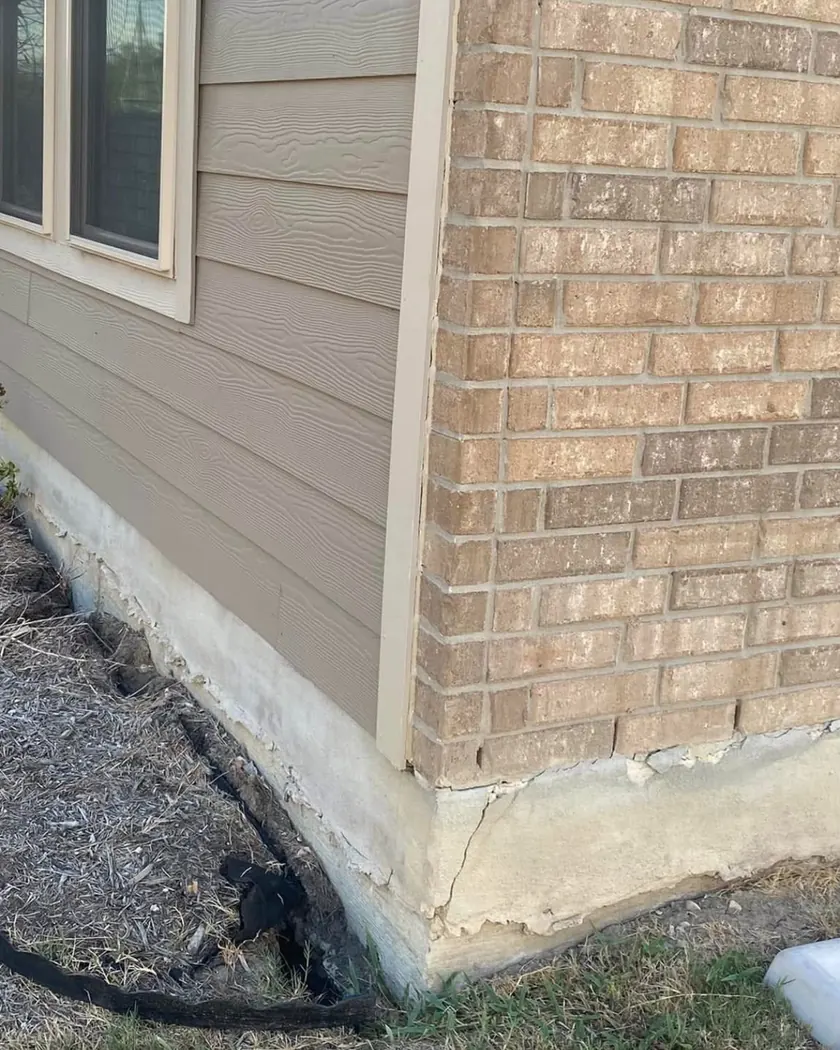
Every inch of rain on 1,000 square feet of roof comes off as roughly 620 gallons. Without a gutter it falls along the drip line. With a gutter and a badly placed downspout, it all lands in a few square feet. On clay, that corner swells in the wet months and shrinks back in a drought, again and again. On the limestone side, the water runs fast over thin soil and carries it away, which is how you get a trench along the eave and a slab edge standing out of the ground.
The photo above is from a real PSG job. The mulch and soil are gone, the edging has pulled loose, and the slab edge is exposed and crumbling. Every storm had been putting the roof water right there.
Signs water is getting to your slab
- Mulch or soil washed out under one part of the eave, or a trench along the drip line
- An exposed or crumbling slab edge at a corner
- Water standing against the foundation after it rains
- Soil pulling away from the slab in a long dry spell
- A downspout pointing straight down beside the wall with nothing to carry the water away
Cracks in brick, doors that start sticking, or gaps opening at window frames can be signs of foundation movement. If you see those, have a foundation company look at it. Our part is making sure the roof is not adding to it.
Where the water lands, and what happens
| Where roof water ends up | What it does |
|---|---|
| No gutter, off the drip line | Cuts a trench along the eave and splashes the wall and slab edge every storm |
| Downspout straight down at the corner | Puts the whole run's water in a few square feet next to the foundation |
| Downspout onto a splash block | Spreads the water and stops the hole digging, but still close to the house |
| Extension or kickout carrying water away | Sends it out onto ground that falls away from the slab |
| Into a rain tank with an overflow | Keeps the water, and sends the overflow away from the house in a big storm |
Where the water should go
Three things, in order.
Catch it. A gutter sized for the roof above it, so it does not overflow at the corner in a hard rain. If yours spills even when it is clean, it is probably too small. Read five inch versus six inch gutters.
Put the downspout where the water arrives. Not where it looks tidy. Then give it somewhere to go: an extension, a kickout, a splash block at the very least.
Send it onto ground that falls away. The model residential code calls for the ground to drop at least six inches in the first ten feet away from a house. If your yard slopes back toward the slab, even a perfect gutter is working against it.
Tight lots and big lots
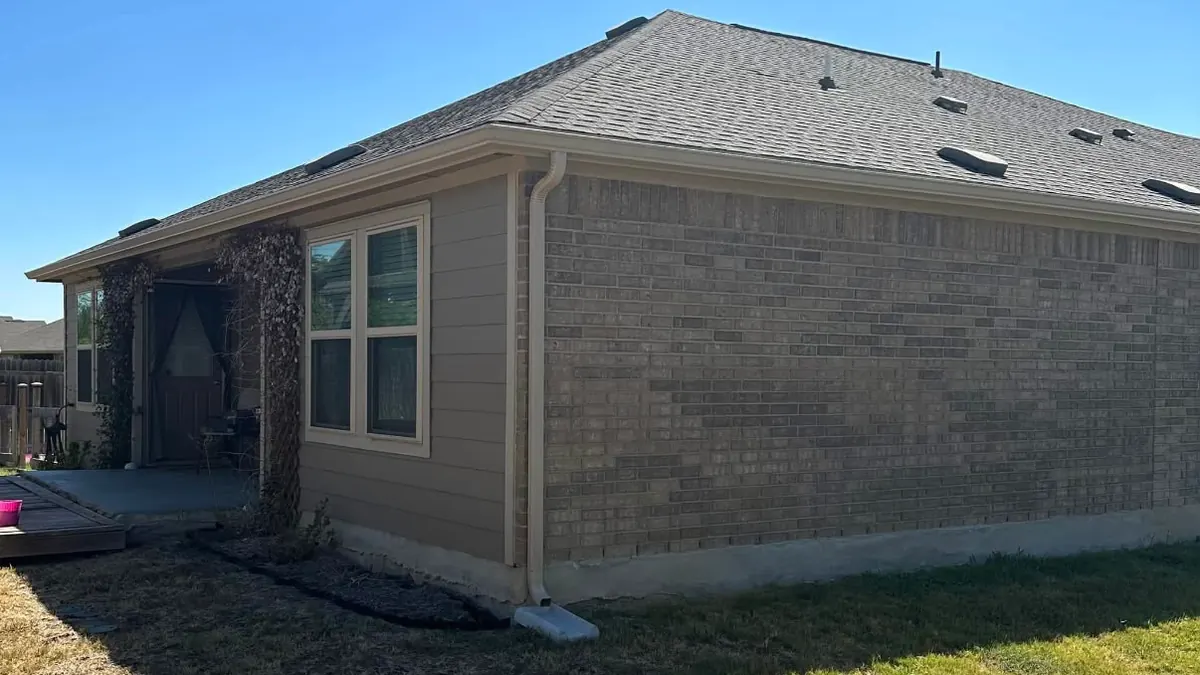
On a tight lot in Cibolo or the older streets in Marion, there is sometimes not much room between a downspout and the fence line. That is when we route a downspout to the opposite corner, because it is the only side with anywhere for the water to run. Out toward Geronimo on open rural ground, there is usually somewhere sensible to send it, which makes that part of the job easier. In New Braunfels itself, where the ground changes from limestone to clay across town, we look at every downspout's landing spot before we quote.
If you already have a problem corner
Start with the gutter. If a run is sagging, holding water or pouring over one spot, a gutter repair or a correctly sized new run fixes the source. If you are on acreage and would rather keep the water, rainwater collection can take it into a tank, as long as the overflow goes somewhere other than your foundation. Call 830-660-9448 and we will come look at where your water is going.
More guides: Five inch versus six inch gutters: which one your house needs, What seamless gutters cost in New Braunfels, and what drives the price, Gutter guards with live oaks and cedar elms: what works and what does not, What happens on install day.