How much water your roof actually sends
Every inch of rain that falls on 1,000 square feet of roof comes off as roughly 620 gallons of water. That is plain arithmetic, not a sales number. A 2,000 square foot roof in a two inch storm puts about 2,500 gallons into your gutters.
The total is not really the problem. The problem is how fast it arrives and where. A Central Texas storm can drop an inch or more in an hour, and your roof does not share that water out evenly. A valley collects two roof faces and delivers them to one short stretch of gutter. A long unbroken roof plane sends everything to one run. A metal roof sheds faster than shingle, so the water hits the gutter in a heavier sheet.
That is why a gutter can cope with most of the house and still overflow at one corner every time it storms.
Five inch and six inch side by side
| Five inch K-style | Six inch K-style | |
|---|---|---|
| Best for | Small, simple roofs, one story, short runs, few or no valleys | Long roof planes, valleys, steep or metal roofs, bigger two-story elevations |
| Water it moves | Enough for a modest roof area per run | A lot more, because the channel is wider and deeper |
| Under trees | Narrower channel, so leaves and pecan husks bridge the outlet sooner | More room for debris to move past the outlet instead of jamming it |
| Downspouts | Usually needs more of them for the same roof | Often needs fewer to move the same water |
| On the house | Slimmer profile on the fascia | A bigger profile, which a matched color hides well |
| Price | Costs less | Costs more |
Signs your five inch gutters are too small
- Water sheets over the front edge in a hard rain, even right after the gutters were cleaned.
- The overflow always happens at the same spot, usually below a valley or at the low end of a long run.
- There is a washed-out strip of mulch or bare soil under one part of the eave and nowhere else.
- The downspout is running full and the gutter above it is still spilling.
If the overflow only happens when the gutter is full of leaves, size is probably not your problem. Cleaning or a guard is. If it happens clean, the run is undersized, the pitch is wrong, or the outlet is blocked. All three are quick to check on site, and our gutter repair page goes through the pitch side.
When five inch is the right answer
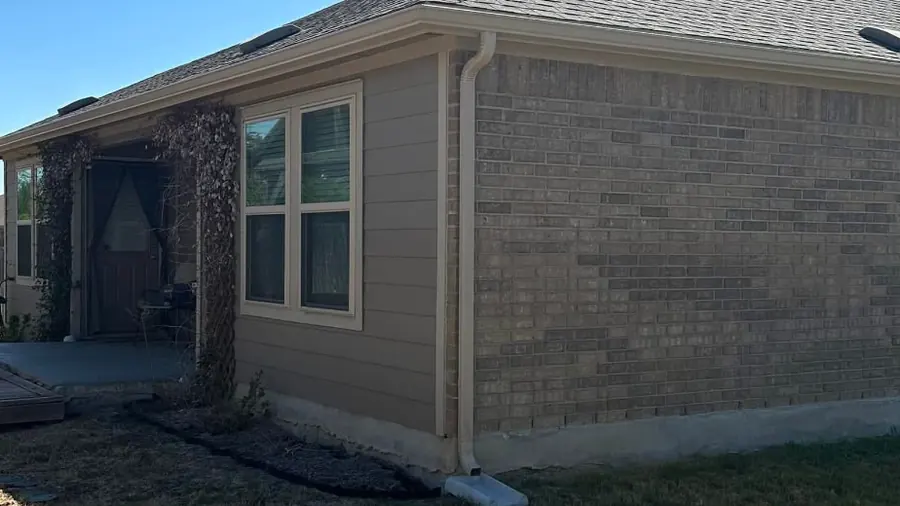
Most homes around here were built with five inch gutters and one downspout per run, and on a lot of them that is fine. A single-story house with a simple roof, short runs, no big valleys and no trees hanging over it does not need six inch. You would be paying for capacity you never use.
When that is your house, we will tell you, and you will pay less.
The houses that push you to six inch
Four situations come up again and again across the area:
- Big builder elevations. A lot of the subdivision building in Schertz went up with five inch sectional gutter on two-story homes with long roof planes. Swapping that for six inch with an extra downspout is the most common job we do there.
- Deep valleys. Newer houses in Cibolo lean toward big continuous rooflines. The fix is often not a bigger gutter all the way around, but the right size on the one run that takes the valley, with the downspout placed where the water lands.
- Metal roofs. Up around Canyon Lake and Spring Branch, standing-seam roofs shed fast and throw water further off the edge. Six inch is the sensible default there, not an upgrade.
- Heavy tree drop. Pecan country around Seguin puts husks and twigs in the gutter, and a wider channel gives them room to move past the outlet.
It does not have to be the same size all the way around
People assume the whole house has to be one size. It does not. Sometimes the back of the house, under the valley, needs six inch and the front is fine at five. We measure the roof area feeding each run, look at the pitch, the valleys and the trees, and size each run for the water it actually gets.
Whichever size goes up, it is rolled on your driveway in one piece per run, hung on hidden hangers and pitched toward the downspouts. That part does not change. You can read how a job goes in what happens on install day.
Does six inch cost a lot more?
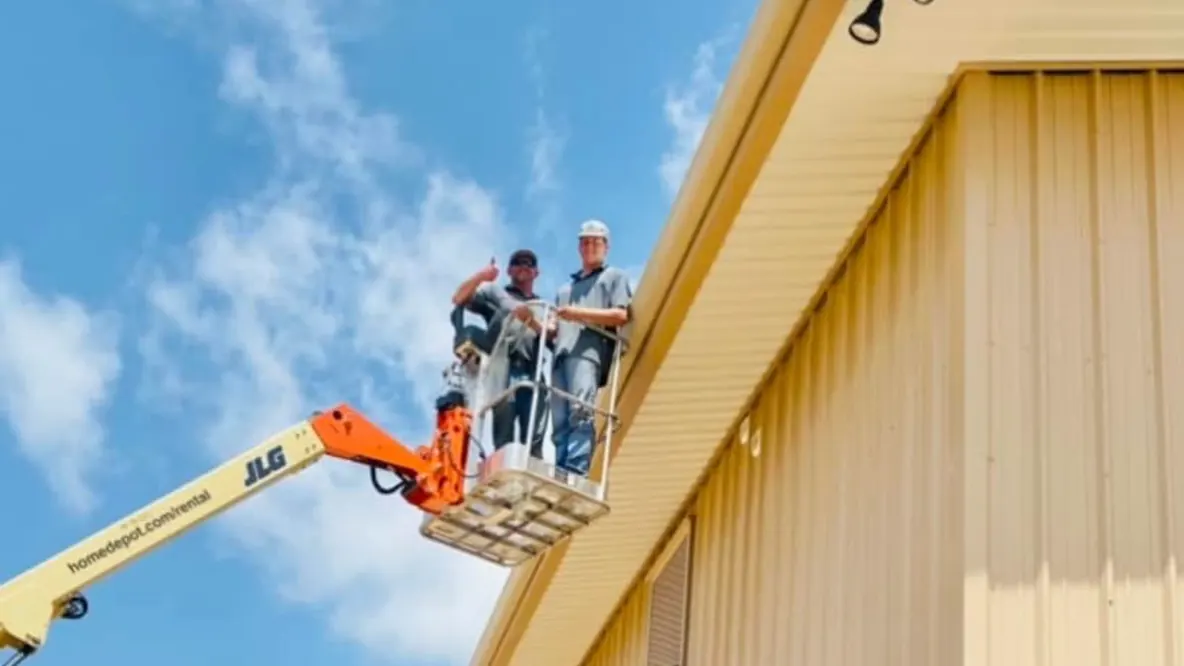
It costs more than five inch, because there is more material in every foot. How much more depends on the house, and on whether the bigger gutter lets you get away with fewer downspouts. Our guide to what gutters cost in New Braunfels goes through everything that moves the number.
Getting the size right
You do not have to work this out yourself. Call and we will come look, measure the roof, and tell you which size each run needs, even when the answer is the cheaper one. Start with our gutter installation page, or call 830-660-9448.
More guides: What seamless gutters cost in New Braunfels, and what drives the price, Gutter guards with live oaks and cedar elms: what works and what does not, Why water at your slab matters in the Hill Country, What happens on install day.